Files in the Cloud, Data on the Market: What Your Storage Provider Knows About How You Live
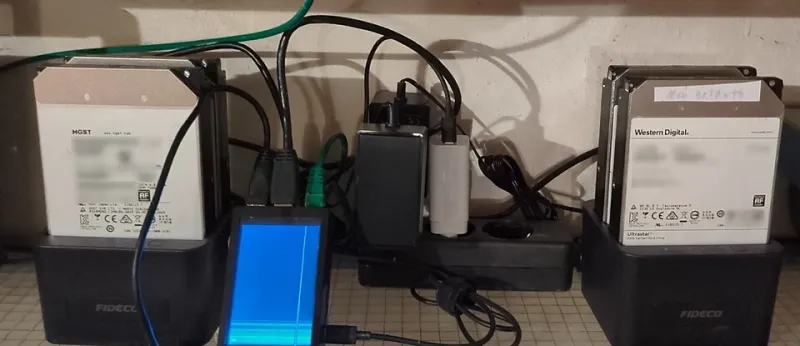
Photo: This image is a work by Wikipedia and Wikimedia Commons user C.Suthorn. When reusing, credit me as described in the Licensing information below. I would appreciate being notified (wikimail, talk page, email, Social Media) if you use my work outsid
For millions of Americans, cloud storage has become as unremarkable as running water. You save a document, back up a photo, share a folder with a colleague — and the whole transaction feels invisible, neutral, almost inert. The files sit somewhere on a server, and you retrieve them when you need them. That is the promise, at least.
The reality is considerably more complicated. The largest cloud storage providers in the United States are not passive warehouses. They are active observers, and the behavioral data they collect about how you use their platforms has become a significant revenue stream — one that most users have unknowingly funded with the most intimate details of their digital lives.
What "Storing Your Files" Actually Means
When you upload a file to a mainstream cloud service, the transaction involves far more than depositing bytes on a remote hard drive. The platform logs the timestamp of your upload, the file type, the file size, and the folder you placed it in. It notes whether you renamed the file, how quickly you accessed it after uploading, whether you shared it and with whom, and how long you spent previewing it.
Taken individually, these data points seem trivial. Aggregated over months and years, they form a surprisingly precise portrait of your habits, your relationships, your professional life, and your anxieties. A person who uploads medical documents in a folder labeled "insurance" on a weeknight tells a very different story than someone who backs up hundreds of RAW image files organized by client name. Cloud providers can infer occupation, health status, financial circumstances, family structure, and even emotional state — all without ever opening a single file.
This is behavioral profiling, and it is happening at scale.
The Specific Data Points Being Extracted
Researchers and privacy advocates have identified several categories of metadata that cloud platforms routinely harvest:
Access patterns. When you open files, how frequently, and from which devices reveals daily routines, work schedules, and geographic movement. A user who accesses spreadsheets from a desktop at 9 a.m. and reviews PDF contracts from a mobile device at 10 p.m. is painting a detailed picture of their professional obligations.
File taxonomy. The way you name and organize folders is a behavioral fingerprint. Folder hierarchies reveal how you think, what you prioritize, and what you are managing at any given time in your life.
Content type distribution. The ratio of video files to tax documents to personal photographs tells platforms a great deal about your life stage, income bracket, and interests — without requiring them to analyze the content itself.
Sharing behavior. Who you share files with, how often, and under what permissions reveals your social and professional network in ways that go well beyond what you might post publicly.
Deletion and modification patterns. Files that are repeatedly edited, or that are uploaded and deleted quickly, can signal stress, indecision, or significant life events — the kind of signals advertisers pay a premium to intercept.
How These Insights Reach Advertisers
The pathway from your file habits to a targeted advertisement is rarely direct, which is part of why it remains poorly understood by the public. Most major cloud providers operate within larger ecosystems — advertising networks, analytics platforms, and data licensing arrangements — that allow behavioral signals to flow outward without the provider technically "selling your files."
The distinction matters legally but is largely meaningless in practice. A cloud service does not need to hand an advertiser your tax return. It only needs to place you in a behavioral segment — "high-income professional," "new parent," "small business owner," "recent home buyer" — and allow that segment to be targeted. The behavioral data extracted from your storage habits is the raw material from which those segments are constructed.
Many providers disclose this practice in terms-of-service language so dense and abstract that it functions, in effect, as no disclosure at all. Consent, in the legal sense, has been obtained. Informed consent, in any meaningful sense, has not.
The Free Tier Problem
The economics of free cloud storage deserve particular scrutiny. When a provider offers fifteen gigabytes of storage at no charge, the cost is not zero — it is deferred and denominated in behavioral data. Free tiers are, by design, the most aggressive data collection environments these platforms operate. The user who pays nothing is, in the most literal sense, the product.
Paid tiers offer somewhat more protection in some cases, but the data collection practices of major providers are not always calibrated to subscription status. Unless a provider explicitly commits to not analyzing user behavior for advertising or data-licensing purposes — in plain language, not legal boilerplate — the assumption should be that the analysis is occurring regardless of what you pay.
Alternatives Built Around True Data Ownership
The market for privacy-respecting cloud storage has matured considerably in recent years, and American users now have credible alternatives that do not depend on behavioral monetization.
End-to-end encrypted storage services — those in which encryption keys are held exclusively by the user, not the provider — represent the most robust structural protection. If the provider cannot read your files, it cannot meaningfully analyze them. Services built on zero-knowledge architecture fall into this category.
Self-hosted solutions have become more accessible for technically inclined users. Running your own cloud storage on a home server or a privacy-respecting virtual private server means your behavioral data never leaves infrastructure you control.
Open-source platforms with transparent codebases allow independent auditing of what data is actually collected. Transparency of this kind is not a guarantee of privacy, but it is a precondition for accountability.
When evaluating any alternative, the critical questions are: Does the provider hold encryption keys? Does the terms of service explicitly prohibit behavioral analysis for advertising or data licensing? Is the business model one that does not require monetizing user behavior to remain viable?
Reclaiming the Filing Cabinet
Cloud storage was sold to the American public as convenience — a way to access your files from anywhere, protect them from hardware failure, and share them effortlessly. Those benefits are real. But convenience has a cost that was never clearly stated on the label.
The files you store are not just files. They are a continuous record of how you work, how you worry, how you plan, and how you live. Treating them as such — and demanding that the platforms entrusted with them do the same — is not paranoia. It is the minimum standard of care that your data deserves.
Owning your data does not require abandoning the cloud. It requires choosing cloud services that treat your files as your property, not as raw material for someone else's revenue model.